
R.I.L.-Games project
Ráció-Intuíció-Logika✳Rationality-Intuition-Logic

It develops thinking skills, keeps players motivated, and continues to provide challenges in the long term.
Knowledge and learning become an experience.
The digital game mode is available with multilingual support:

RIL-Games is a game platform that brings together multiple game groups built on different logical and mechanical principles. Its difficulty system goes far beyond simply increasing the size of the game board. Different rotation rules, varying movement mechanics of the game elements, combinations of colors and numbers, and the unique settings of each game mode create a wide range of challenges that require new thinking strategies at every level and place an increasing emphasis on spatial reasoning.

Whether you play on a smaller or a larger board, the real challenge always comes from the complex combination of rules. This is what keeps the RIL-Games experience continuously varied, unpredictable, and engaging over the long term.
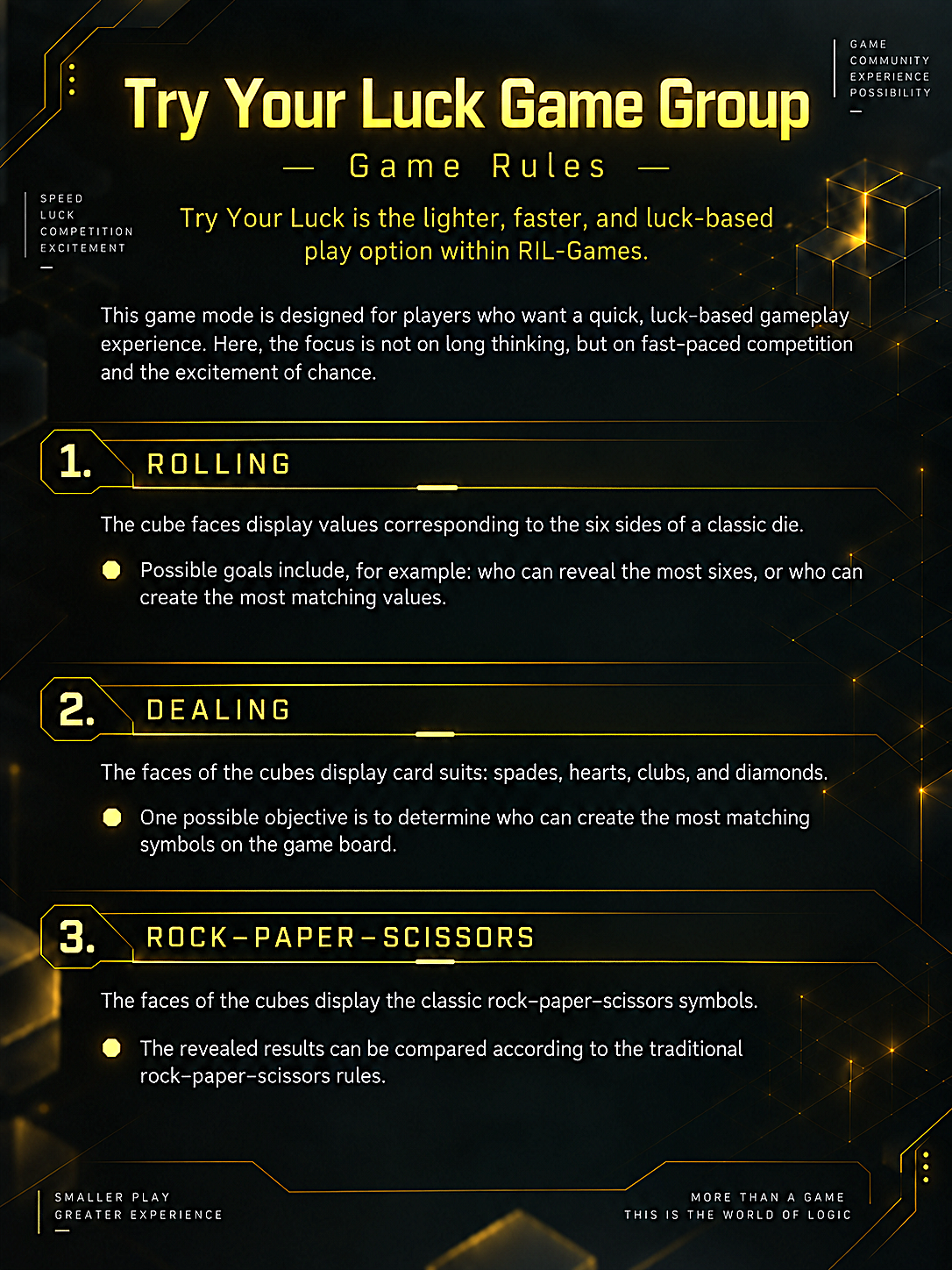
In addition to its Entertainment Games – including Kids and Try Your Luck – RIL-Games also offers Game Groups I, II and III, all built on shared logical foundations.

II. Planned for a later releasease.
III. Planned for a later release.
RIL-Group will be the first of the game groups to launch.
Expected release: September 30, 2026.
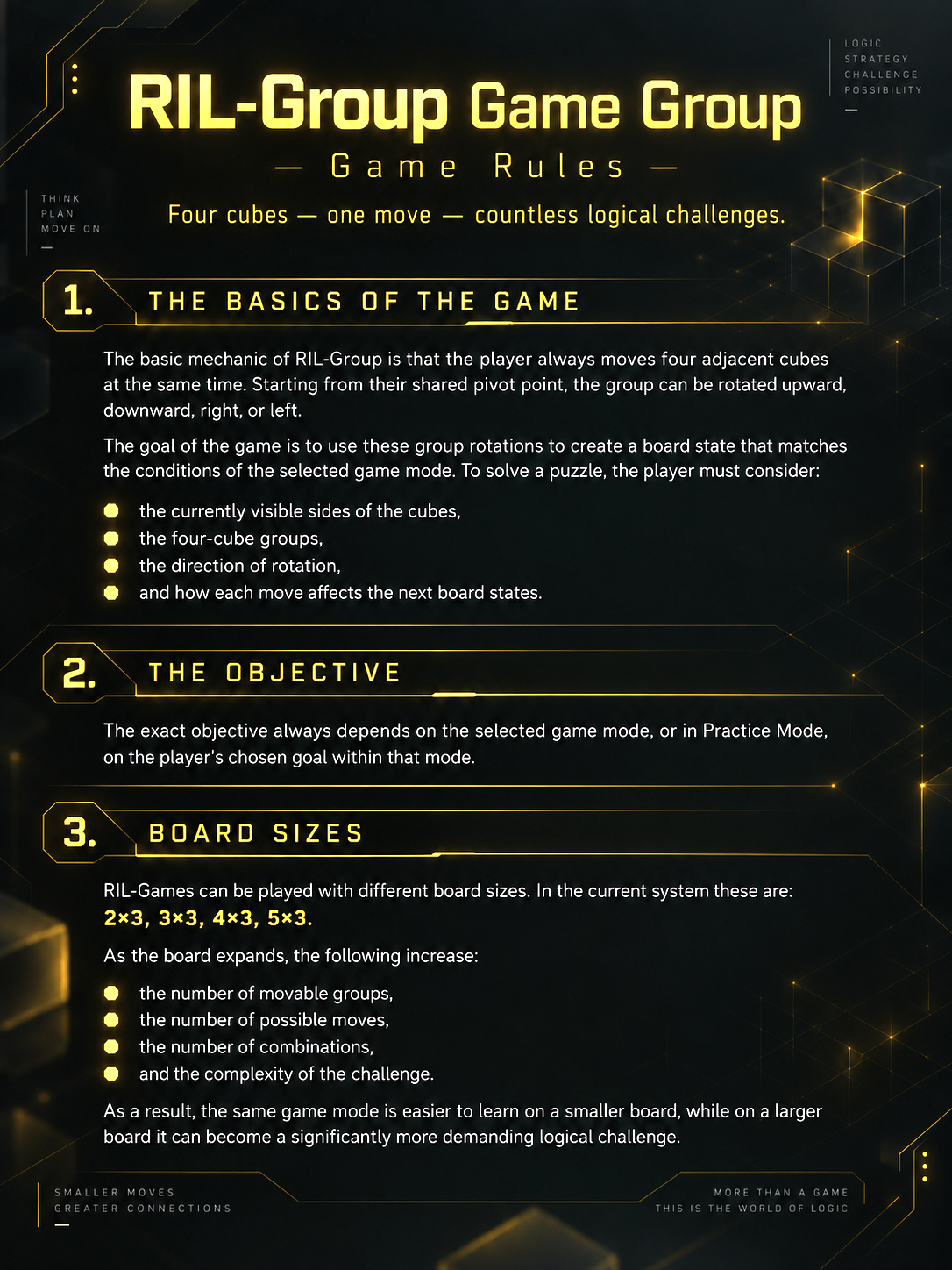
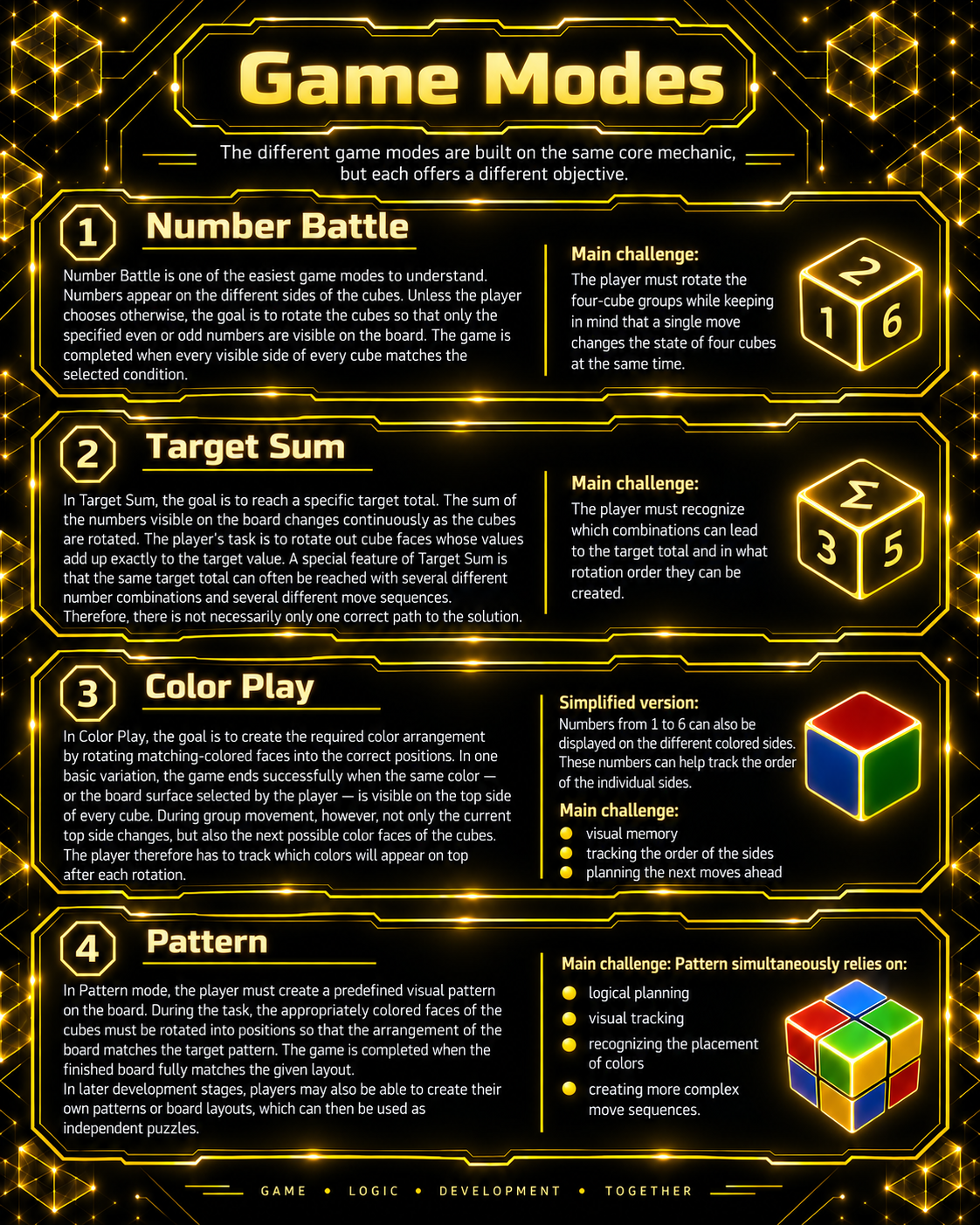
The system currently includes four core game modes which, when combined with different board sizes, play directions and settings, allow for a large number of variations.
Custom-designed illustrations also offer easy-to-learn casual gameplay experiences for young children, helping the game reach a wider audience while providing an accessible entry point into more advanced logical and strategic challenges.
Custom settings will be available soon.

The goal of the game from a skill-development perspective:
- logical and analytical thinking, as well as focus and concentration skills,
- spatial awareness, visual and photographic memory,
- recognizing connections and improving learning abilities,
- flexibility in thinking and problem-solving skills,
- concentration, patience, and understanding cause-and-effect relationships,
- forward thinking, planning, and maintaining sustained attention,
- the ability to solve tasks creatively through data analysis,
- memory and pattern recognition,
- strategic planning and foresight.
💡 Development through gameplay → a new success with every level.

Who is it designed for?
- Children and beginner players, because:
- easy-to-understand gameplay from the start,
- safe and supportive game mechanics,
- continuous sense of achievement.
💡 The game does not "punish" the player — it teaches through experience.

Information about the specially designed "Kids" mode for young children can be found below.
2. Advanced players and logic enthusiasts
- more complex pattern recognition,
- strategic thinking,
- creative and extra challenges.
💡 The longer you play, the deeper layers of logic reveal themselves.

3. For educators and development professionals
- built on cognitive psychology principles,
- spiral learning structure,
- suitable for differentiated skill development.

Why is RIL-Games special?
The difficulty of the tasks is determined not only by the size of the game boards, but also by the defined solution goals.
- Gradually increasing difficulty levels — a safe and supportive learning curve.
- Multiple cognitive skills develop simultaneously.
- Enjoyable for beginners, challenging for advanced players.
- Available digitally, with physical and logic-circuit-based versions planned for the future.
- Valuable for children, adults, and educators alike.
💡 A developmental tool that still remains a game.
About the digital version:
Each game mode consists of multiple progressively more difficult levels.
The complexity of the game field is determined by:
- the number of tiles,
- the combinations of rotation and flip directions,
- the combinations of colors, numbers, and illustrations.


Expected release: October 30, 2026

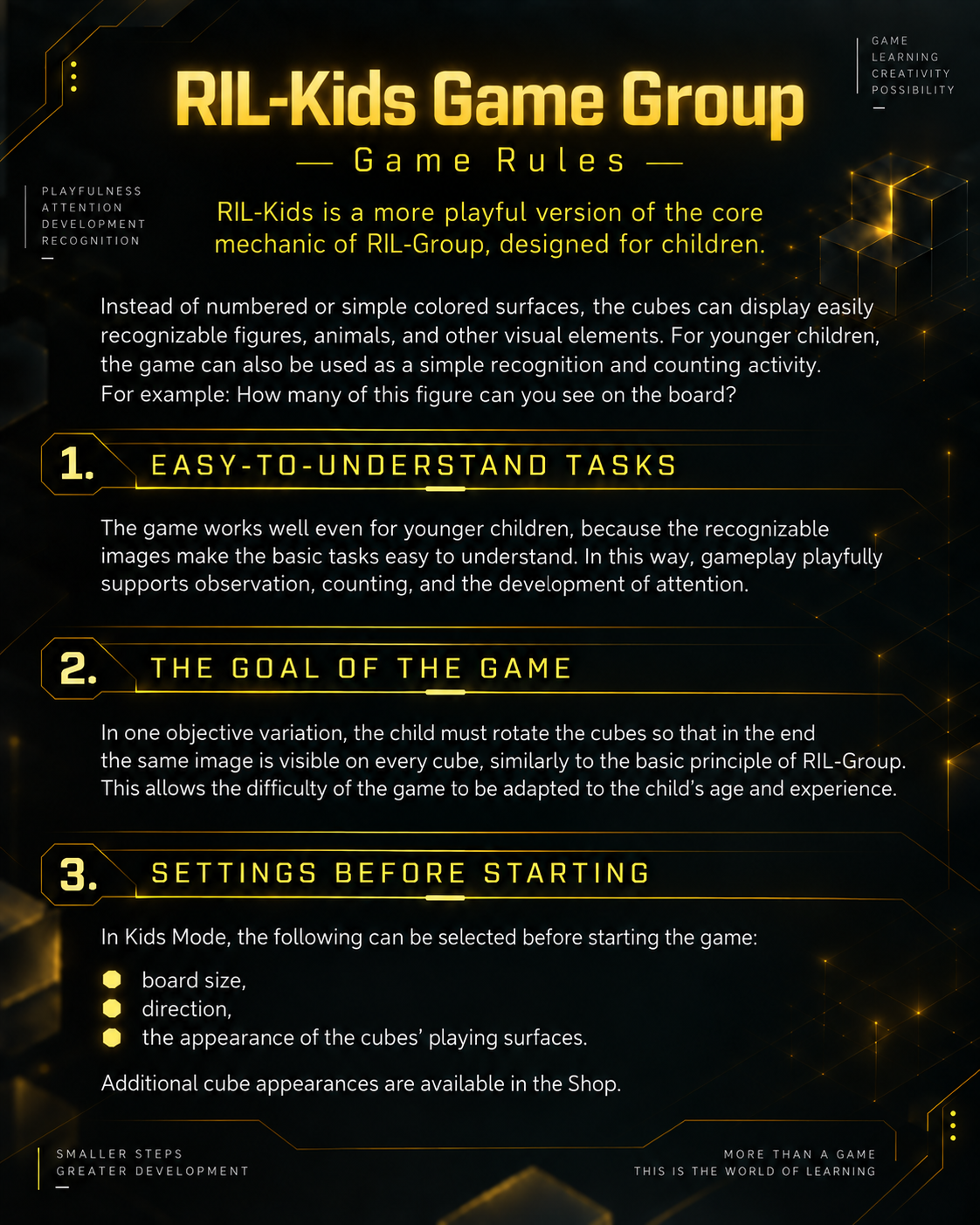
Expected release: September 30, 2026.


The first available game modes will be RIL-Group and RIL-Kids.
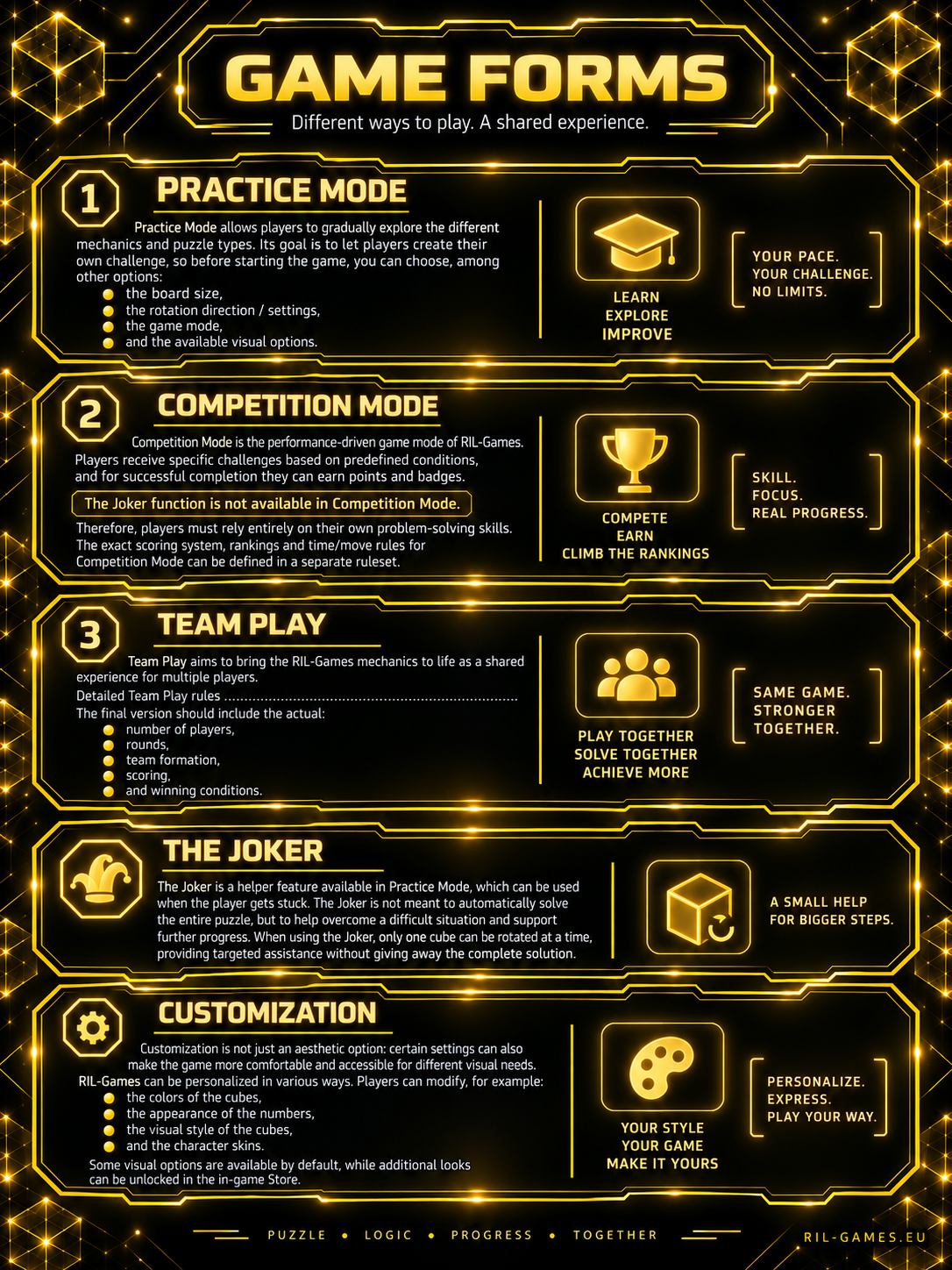
While RIL-Kids offers 12 standalone variations, the other game modes are primarily divided into Practice, Competition, and Team play formats.
In Competition mode, you can earn points and badges for successfully completed challenges, but the Joker function is not available.
Practice mode allows players to improve using settings that match their own skill level. Difficulty levels, board sizes, and play formats can be freely combined.
In Creative Mode, players will later be able to design their own game boards, allowing the game to keep evolving with new challenges.

Digital Version — an interactive logic-based application.
Physical Version — a tangible, spatial gameplay experience.
Logic Circuit Version — screen-free, hardware-based logical thinking.
💡 The same thinking experience in multiple forms.

💬 Why players may love the game
"Even beginners can experience success, but later it becomes a serious logical challenge."
"A developmental game that children do not want to stop playing."
"Excellent for classroom development activities — well-scaled difficulty progression."